


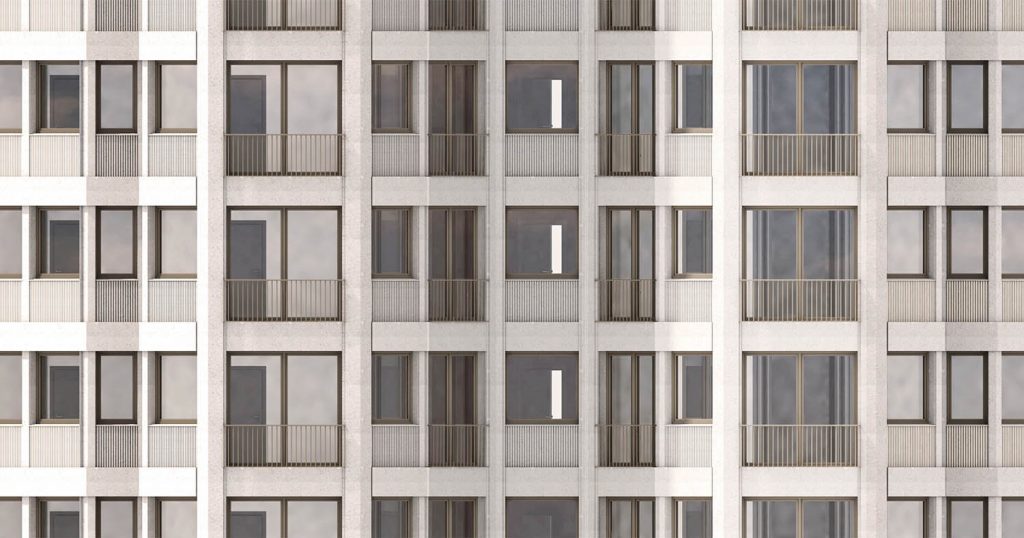
Facade view
© Laure Nashed
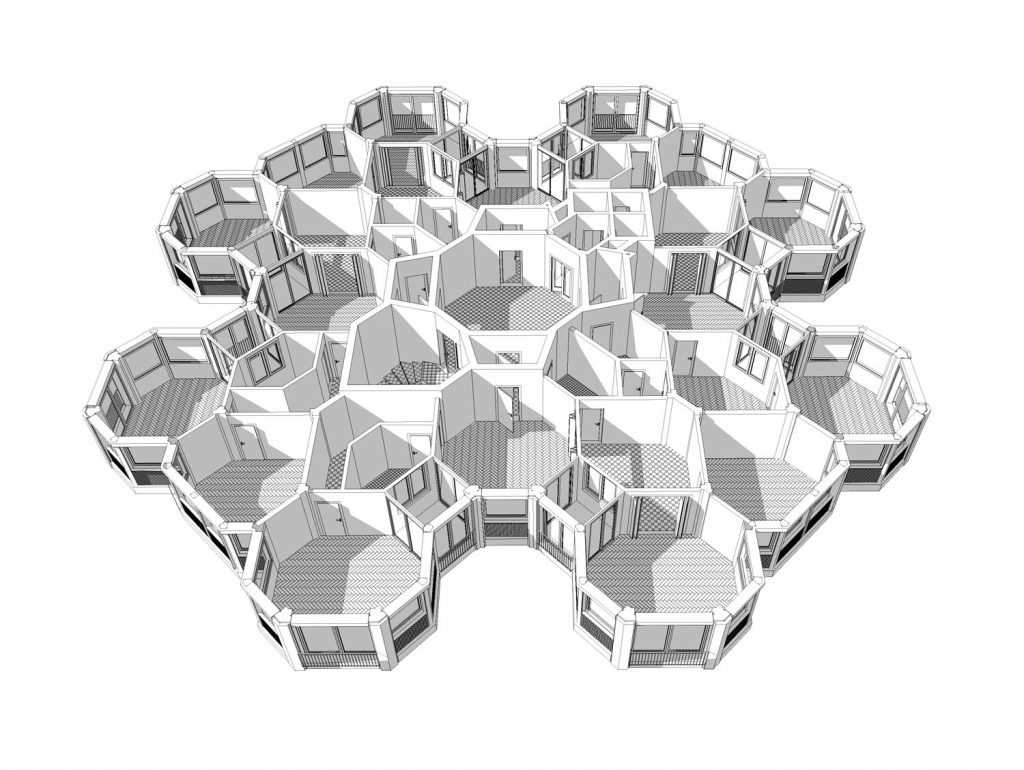
Axonometric drawing of a storey © Laure Nashed
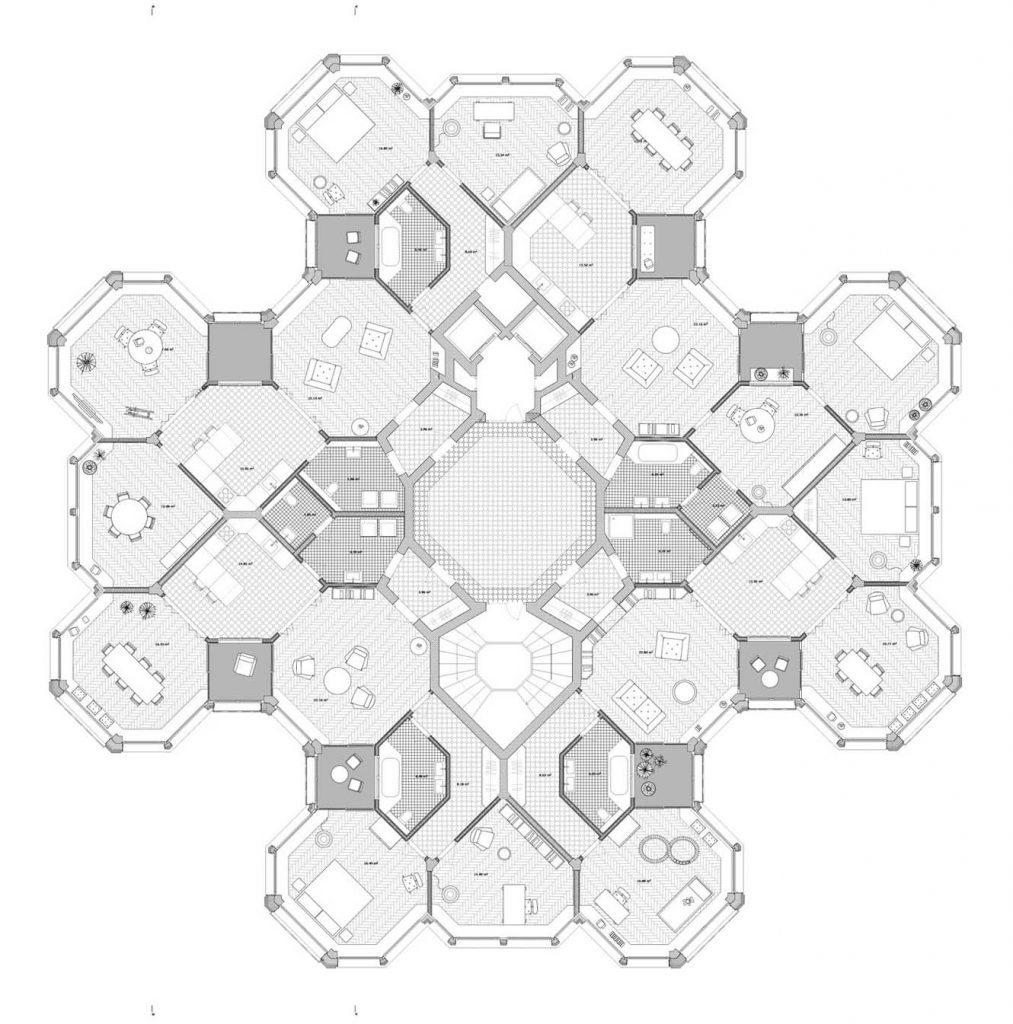
Layout standard floor
© Laure Nashed
› 2014, Design project in the master’s studies at ETH Zurich with Prof. Mike Guyer.
› The theme of structure marked the concept of the design with Mike Guyer. In my search for a structurally interesting grid to subdivide the floor plan, I came across various compact geometric patterns that sparked my interest. Especially historical buildings from the Renaissance that followed strict geometric rules. But also Auguste Perret created floor plans at the beginning of the 20th century that were characterised by a grid, mainly for constructional reasons. After intensive research on the subject, I incorporated the gained knowledge into a project for a residential use and tried to adapt it to the allocated building site.
The building site was defined as a workshop hall on the grounds of the SBB repair works in Zurich. The task was to build over this hall without affecting it too much. The challenge resulted in a project whose load-bearing core extends into the hall, while the first flats only begin at a height of 18 metres. The top flat of the tower is at a height of 75 metres.
The focus of the design was on an exciting interplay between structure and space. Two features from the floor plan of the dwellings in Rue Franklin in Paris by Auguste Perret had a fundamental influence on the project: firstly, the compactness of the floor plan with diagonal references between the rooms, and secondly, the atrium in front of the dwellings, which floods the rooms with light despite the depth of the building. The design provides for four appartments per floor, which are reached via an octagonal access space. The flats consist of three main rooms and adjoining rooms behind them. Two winter gardens can be used as a direct connection between the main rooms and bring additional light into the interior spaces. The façade is supported by columns that are left visible. Non-load-bearing elements on the façade are set back.
› 2014, Design project in the master’s studies at ETH Zurich with Prof. Mike Guyer.
› The theme of structure marked the concept of the design with Mike Guyer. In my search for a structurally interesting grid to subdivide the floor plan, I came across various compact geometric patterns that sparked my interest. Especially historical buildings from the Renaissance that followed strict geometric rules. But also Auguste Perret created floor plans at the beginning of the 20th century that were characterised by a grid, mainly for constructional reasons. After intensive research on the subject, I incorporated the gained knowledge into a project for a residential use and tried to adapt it to the allocated building site.
The building site was defined as a workshop hall on the grounds of the SBB repair works in Zurich. The task was to build over this hall without affecting it too much. The challenge resulted in a project whose load-bearing core extends into the hall, while the first flats only begin at a height of 18 metres. The top flat of the tower is at a height of 75 metres.
The focus of the design was on an exciting interplay between structure and space. Two features from the floor plan of the dwellings in Rue Franklin in Paris by Auguste Perret had a fundamental influence on the project: firstly, the compactness of the floor plan with diagonal references between the rooms, and secondly, the atrium in front of the dwellings, which floods the rooms with light despite the depth of the building. The design provides for four appartments per floor, which are reached via an octagonal access space. The flats consist of three main rooms and adjoining rooms behind them. Two winter gardens can be used as a direct connection between the main rooms and bring additional light into the interior spaces. The façade is supported by columns that are left visible. Non-load-bearing elements on the façade are set back.


